Sahainan Permaculture Organic Farm
Nan
Features At This Location
A family-run food forest and permaculture education center in the mountains of Nan.
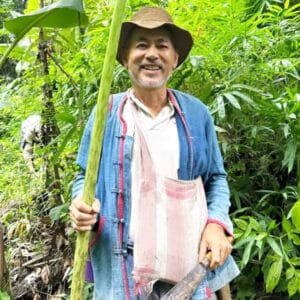
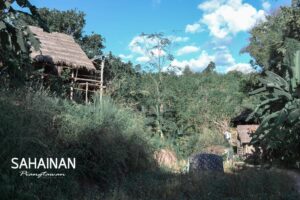
Sahainan Permaculture Organic Farm is nestled in the mountains of Thung Chang district, roughly 80 km north of Nan city. Founded in late 2014 by Sandot Sukkaew, a member of the Lua (Lawa) hilltribe, and his partner Shen, the farm sits on 5.5 acres (14 rai) of land that was barren and waterless when they arrived. Over a decade of restoration work has transformed it into a thriving, biodiverse food forest with over 100 plant species and even restored spring-fed rivers created through reforestation.
The name carries dual meaning: "Sahai" (สหาย) means "companions", reflecting the communal ethos, while "Nan" references both the province and water (สหายน้ำ, "companions of water"), honoring the spring-water restoration that brought the land back to life. The farm's philosophy is rooted in permaculture's three ethics; Care for the Earth, Care for the People, Fair Share, interwoven with traditional Lua farming knowledge passed down through generations.
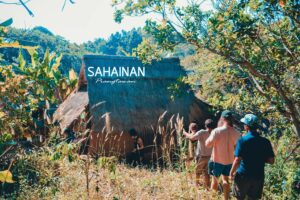
Sahainan operates entirely off-grid: small solar panels provide electricity, spring water flows from the mountaintop, cooking is done over firewood, and structures are hand-built from bamboo, mud, and teak wood. The food forest produces cashew nuts, rambutan, avocado, banana, papaya, mango, jackfruit, durian, coffee, rice (sticky, black, and brown varieties), ginger, turmeric, cardamom, moringa, sacha inchi, passion fruit, cotton, and dozens of medicinal herbs and vegetables. Seed saving and community seed exchange are central practices.
Permaculture techniques in active use include agroforestry and food forest design, natural building, self-composting toilets, charcoal water filtration, biochar and wood vinegar production, effective microorganisms (EM), biogas systems, and grey/black water management. The farm also runs active reforestation and forest fire prevention projects in surrounding areas, successfully regenerating water sources for the broader Thung Chang community.
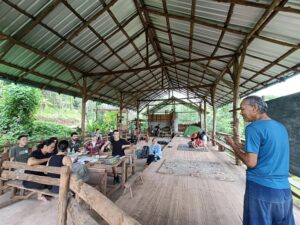
Education is core to Sahainan's mission. The farm offers a 10-day Practical Permaculture Course, 80-day volunteering programs, carpentry internships, and free permaculture education for local village children and farmers. Hundreds of international volunteers have participated over the years, and the farm has been featured in HuffPost's "This New World" series, a ThaiPBS documentary, and Gavroche magazine. Sandot has also served as an external permaculture consultant for Baan Doi children's center in Chiang Rai, in collaboration with BASEhabitat (University of Arts Linz, Austria).
The family; Sandot, Shen, and their homeschooled children Jon Jon and Jai Jai, lives on-site year-round, embodying the philosophy that permaculture is a complete way of life rather than merely a farming method.
How to Get There:
From Nan city (~80 km, 90 min by car): Local bus from Nan Bus Station departs at 6:00, 8:30, 10:30, 14:00, 16:00, 17:00, and 18:00 — journey takes 2–3 hours. Local taxi costs 1,200 THB per trip. From Nan Airport, walk 1 km to the main road and catch a red bus heading north.
From Chiang Mai (~350 km, 5–8 hrs): "Green Bus" from Arkhid Bus Station to Thung Chang (7–9 hrs); book 1–2 days in advance.
From Chiang Rai: Bus from Chiang Rai Bus Station before 8:30 (departs 9:30, one trip daily). Can disembark at Tha Wang Pha; local taxi 800 THB.
From Bangkok (~750 km): Overnight bus from Mochit Bus Station (10–12 hrs). Companies: 999 Transport, Sombatt Tour, Chertchai Tour. Departures at 8:50, 18:00, 18:30, 20:00, 20:30.
From Thai–Laos border (Chaloem Phra Kiat): "Nakhon Nan Yan Yon Minivan" daily at 12:30 (1 hour).
Last mile: The farm is 1 km before Thung Chang town in village Huay Yang, then 3 km uphill to Ban Huay Phan. Drop at Thung Chang bus station, Bang Zhak petrol station, or 7-Eleven, then contact the farm for pickup.
Visiting Policy:
Visitors should come with genuine interest in permaculture and sustainable living. Farmstay guests book via email. Sahainan Volunteers submit an application form on the website or email, confirming dates a few days or weeks before arrival. Course participants register via email with limited spots available. Travel insurance is required for volunteers.