

On a recent visit to Mosaic school, Neil was wearing a tee-shirt that said “Play in the dirt”. This could be a metaphor for the school’s philosophy of active learning. Instead of studying subjects segregated by the hourly school bells, students at Mosaic learn through themes that provide the framework and inspiration for all the teaching. And for the last semester of 2025 the theme is Origins.
At the opening session of the semester, the children, aged from 5 to 15, sat cross legged on the floor while the teachers pitched their classes to the students with each subject framed around the theme of origins. For example – the origin of money (economics), the origin of you ( sociology) and the origin of the universe (astronomy). But also permaculture in two flavors, the origin of flavor and the origin of wealth which would focus on community resilience.
This seemed rather advanced for children as young as five years old but they were full of energy and enthusiasm. Each teacher ended their pitch by saying “I hope you will join my class” – a demonstration of the way the students plan their own learning journey.
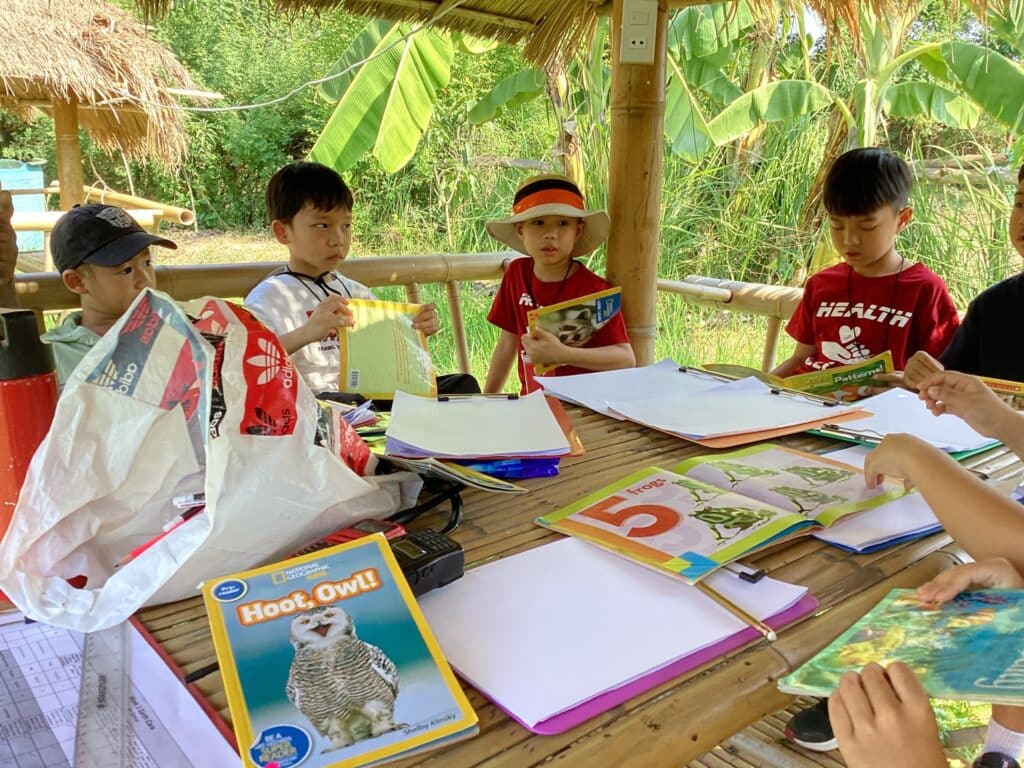
The school was co-founded by Neil and New Zealander Frances Underwood. In the beginning it was licensed as a language school but as numbers of students grew and the direction evolved it became a non-traditional Learning Centre.
Francis explained that although the school followed the Thai curriculum, the methods of teaching were different. Both ages and subjects are integrated – a concept that promotes self-directed learning they call I-Day.
It is similar to the concept of natural learning and homeschooling – in families children aren’t segregated by age, they learn from those who are both younger and older and knowledge is an exploration which is not limited to one subject.
The concept of integration day arose, Neil explains, when they were both teaching at Burapha University’s Piboonbumpen Satit (demonstration school) for primary students.
“We invented I-Day or “Integration Day” one day when there weren’t enough teachers and we had to improvise. It was very successful. We would have classes on the playground and employ self-directed learning. In the beginning the students actually cried! They complained, “Tell us what do! What are we supposed to learn?” However, in a short time, they embraced self-directed learning.”
Francis explained, “the key is to give them learning skills and build character. We want people to think and reason for themselves for lifelong learning.”
While Francis’ interest was in various kinds of alternative education, Neil had a more specific focus – a lifelong interest in permaculture.
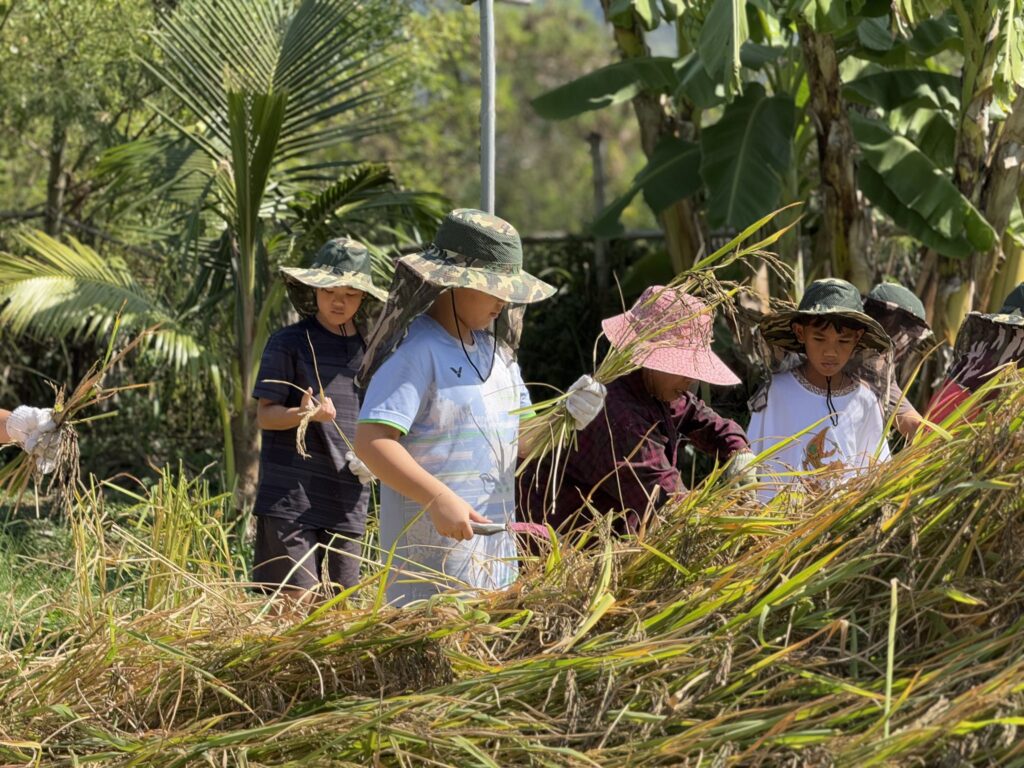
Neil was one of the first students of permaculture, doing courses early in 1980 in Berkeley with one of the co-originators Bill Mollison. Meanwhile, his somewhat eclectic career in the navy which covered oceanography, engineering and other things was influenced by his early interest in permaculture. When he finally “settled” on a discipline, it was physics but he specialised in thermodynamics and more specifically ecological physics. Advanced practitioners of permaculture would recognize the harmony with the early inspirations of the permaculture design concept.
In 2007, about 20 years ago, after nearly 30 years in the navy, he and his wife Su bought a 6 rai (1 hectare) piece of land in the coastal town of Sri Racha. He decided that his best contribution to permaculture would be in the domain of education and culture.

“In my naval career, I had developed a very significant specialty in education including curriculum development and this was further developed later, in my designation as a professor of naval science. My final tour was as the navy’s Director of International Training where I collaterally assumed the role of overseeing the establishment of the Ministry of Education in Afghanistan. This made me completely aware that whatever needs improving in any nation or culture, is probably best addressed at the primary and secondary education level.
This was echoed in anything I did. And permaculture was always in my mind.
“One time we had a buffalo versus a tractor race to prepare a field for rice. The tractor actually won, however, the young students learned that the buffalo had other advantages. Of these, it produces “poo” which can be used as fertiliser.
“Given the opportunity to say “poo” in class was a bit of a dream for the children,” Neil said.
“Finally, the children made a power point analyzing the comparison and they asked me what PPT stood for – I said ‘Powerful Poo Training.’ It took quite a few years before they realised what PPT really stood for!”
Neil and Frances often say children are capable of a lot more than many people realise – if they get the chance.
“We had an eight year old Mongolian student who built a yurt.”
Learning is the essence of permaculture. By teaching children how to learn, they can confidently go forward and effect meaningful change in the world.